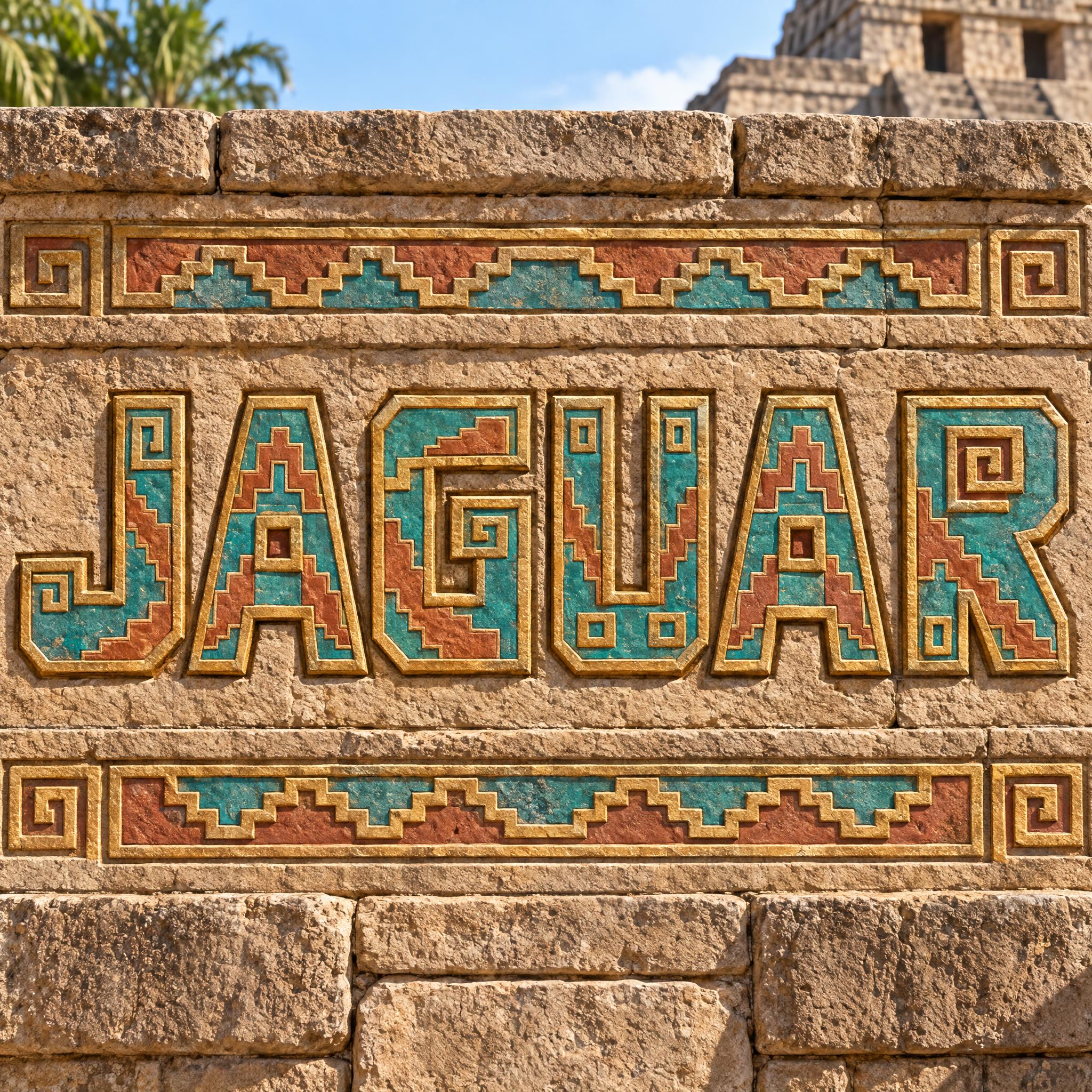
Blocky capitals built from straight lines and right-angle steps, carved with stepped frets and zigzags, in painted turquoise, terracotta and gold.
TextWrite the word "JAGUAR". Spell it exactly as written, without adding or changing any letter.
Font designAztec lettering: bold, blocky capital letters built only from straight lines and right-angle steps, each letter filled with carved geometric patterns of stepped frets, zigzags and small square spirals like a stone relief; every letter reads at a glance. The letters are turquoise and terracotta with gold outlines. The surface looks like painted carved stone with slightly worn edges. Like the carved lettering on an Aztec temple frieze.
SceneThe word is carved into a sunlit sandstone wall with a stepped border. The word is centered, spans most of the width and reads clearly.
108 words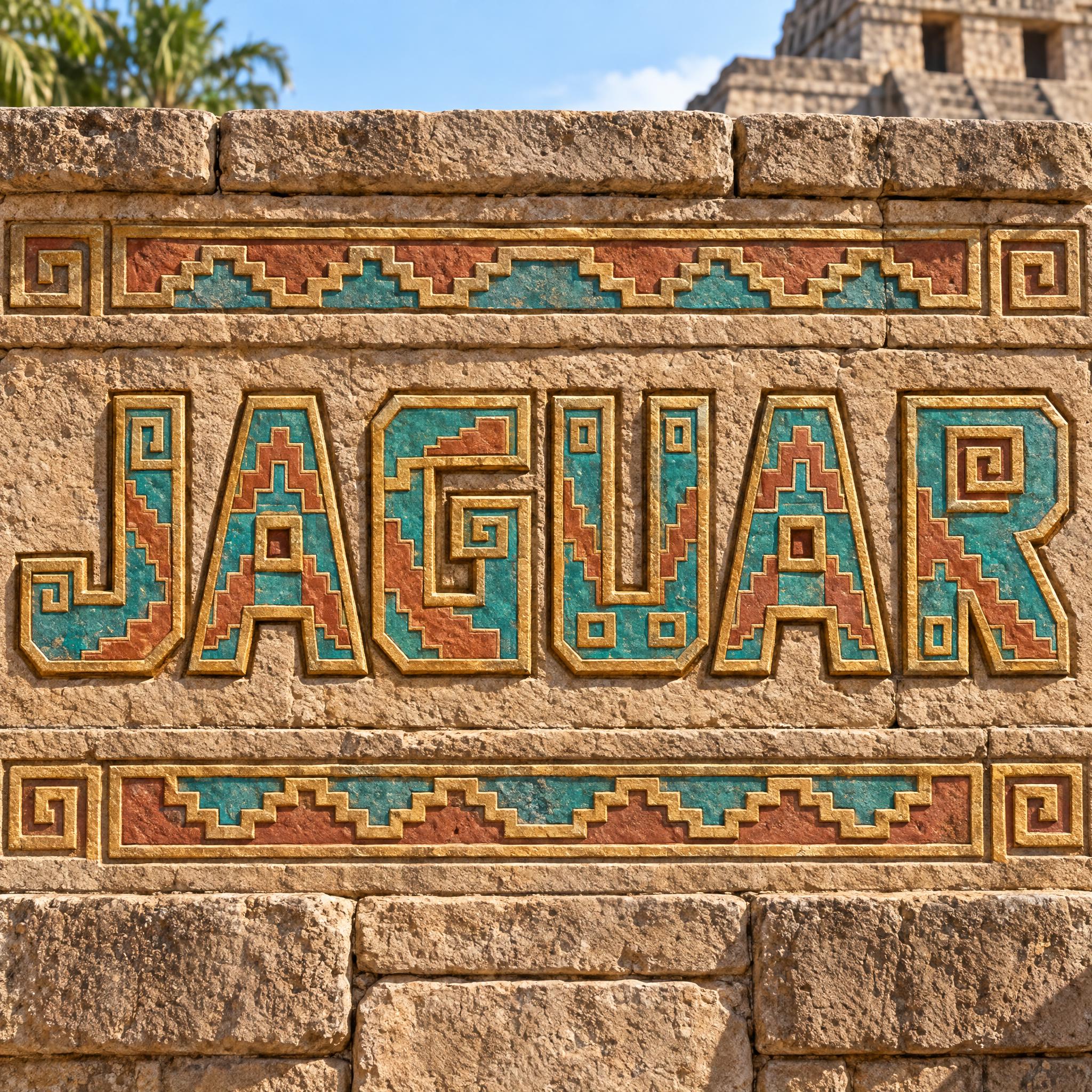
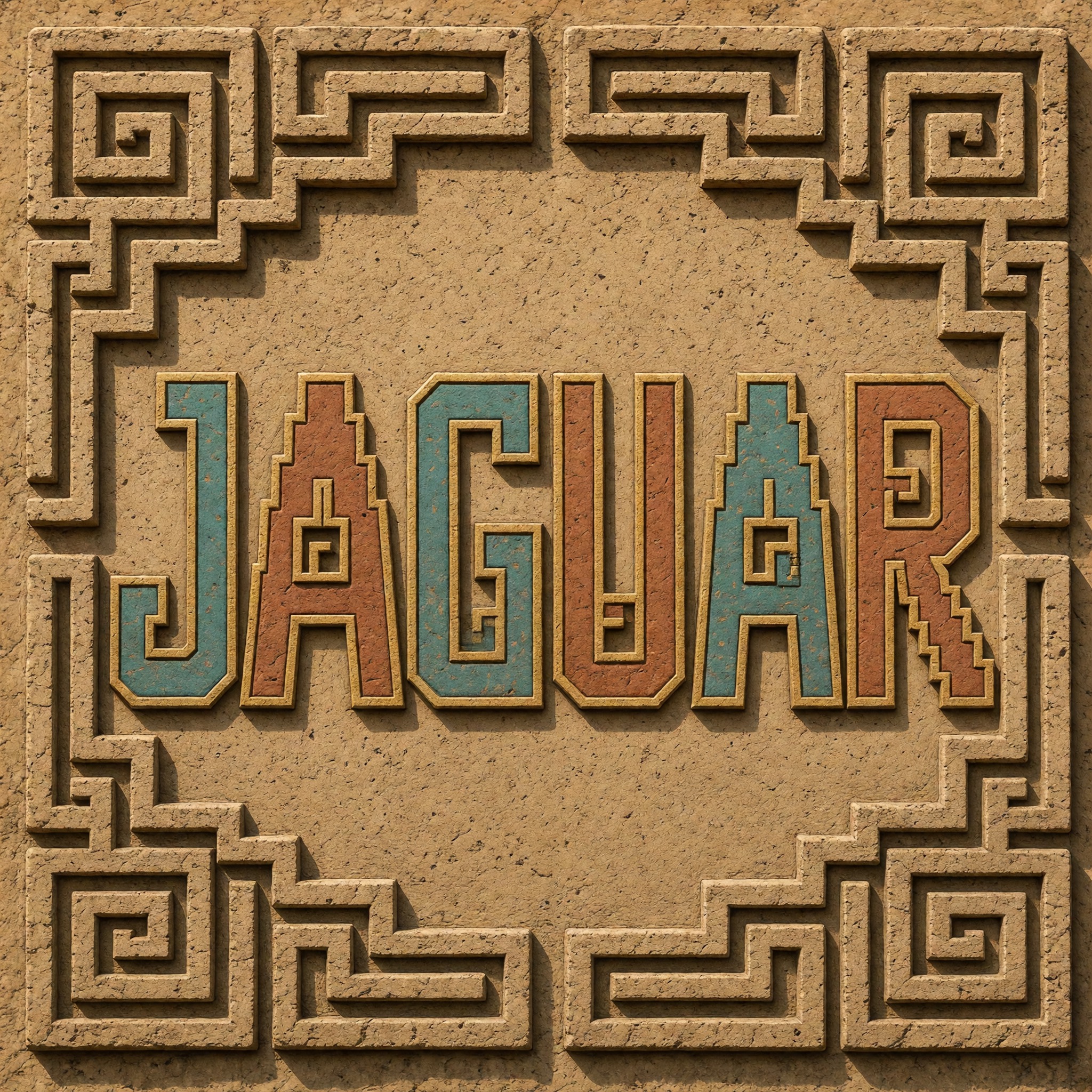
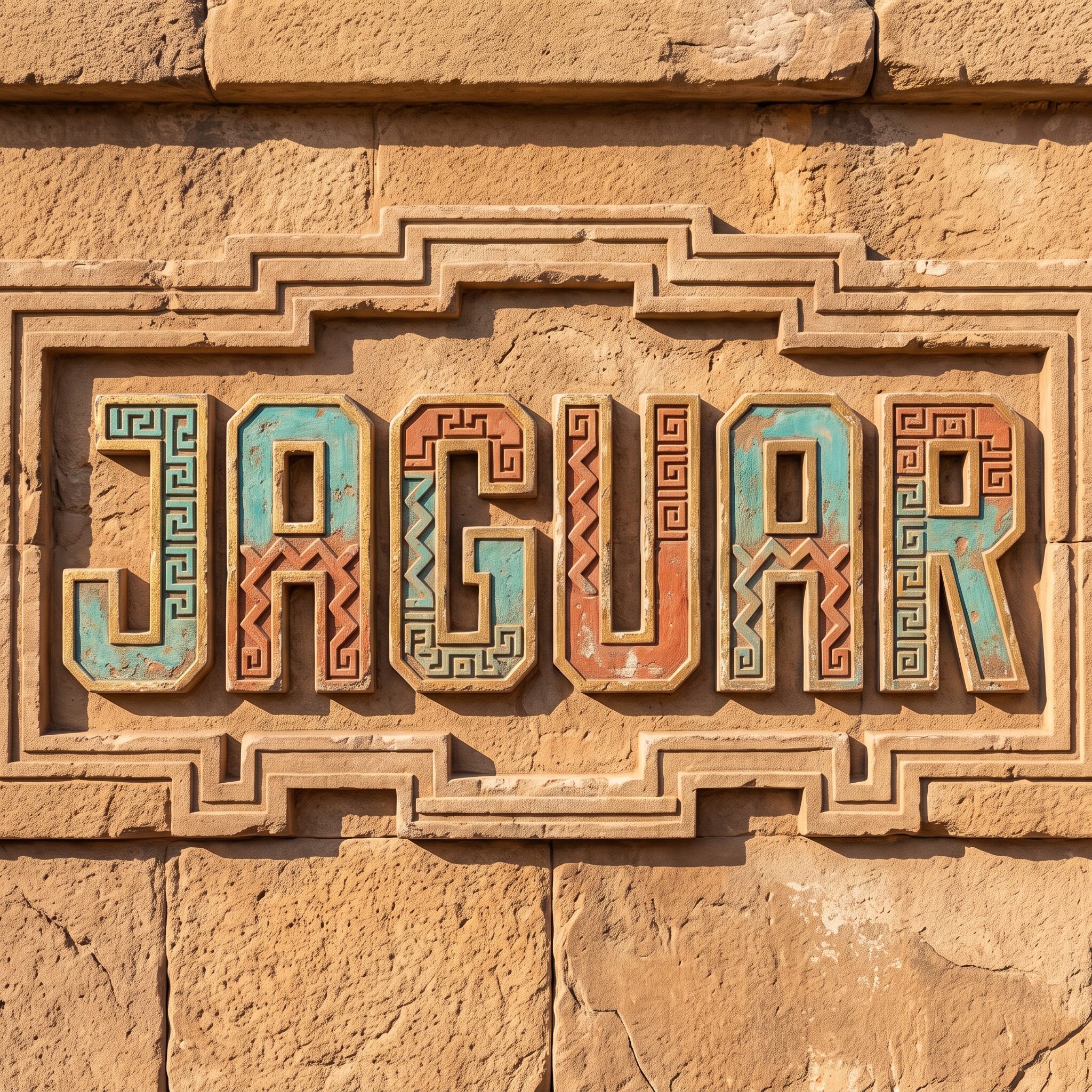
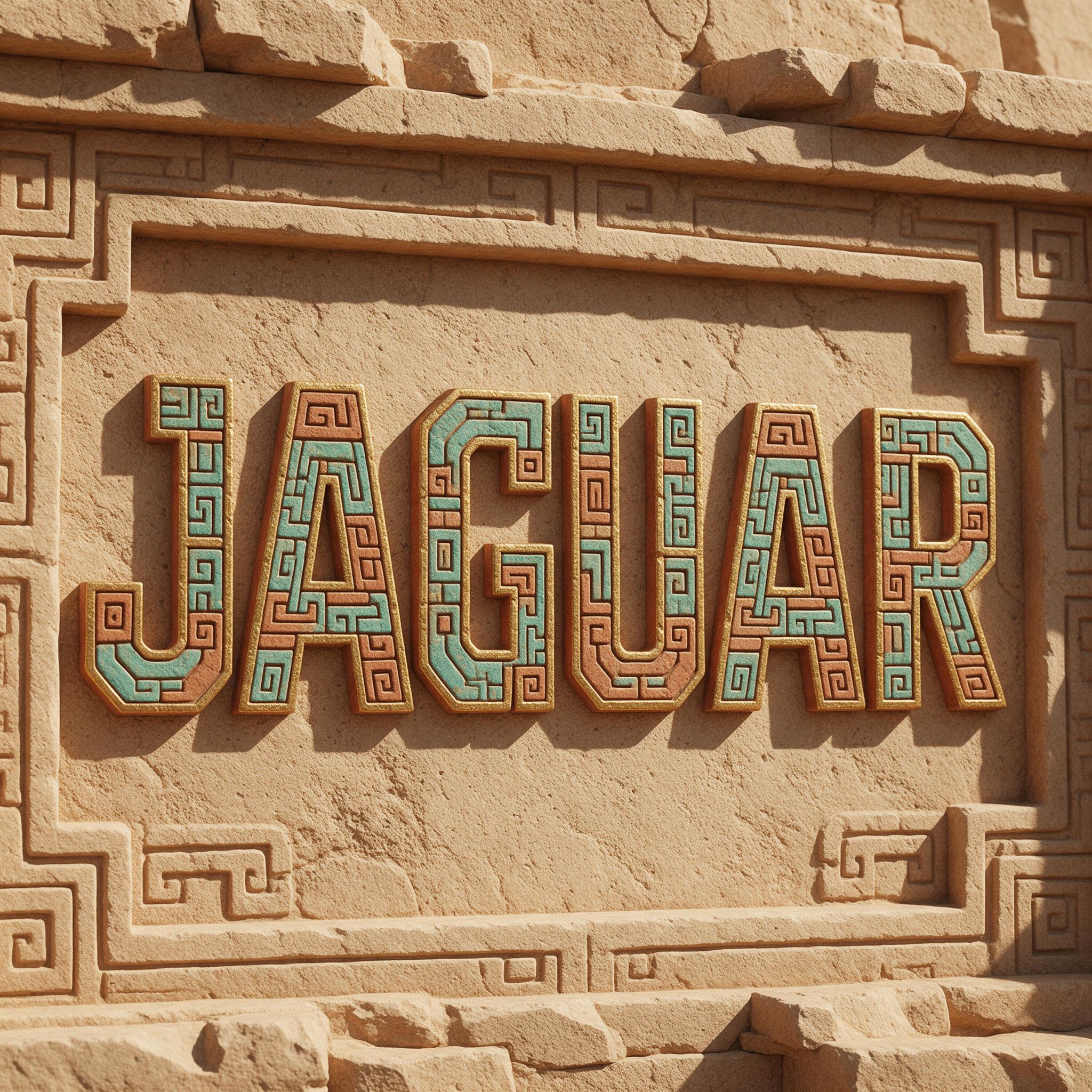
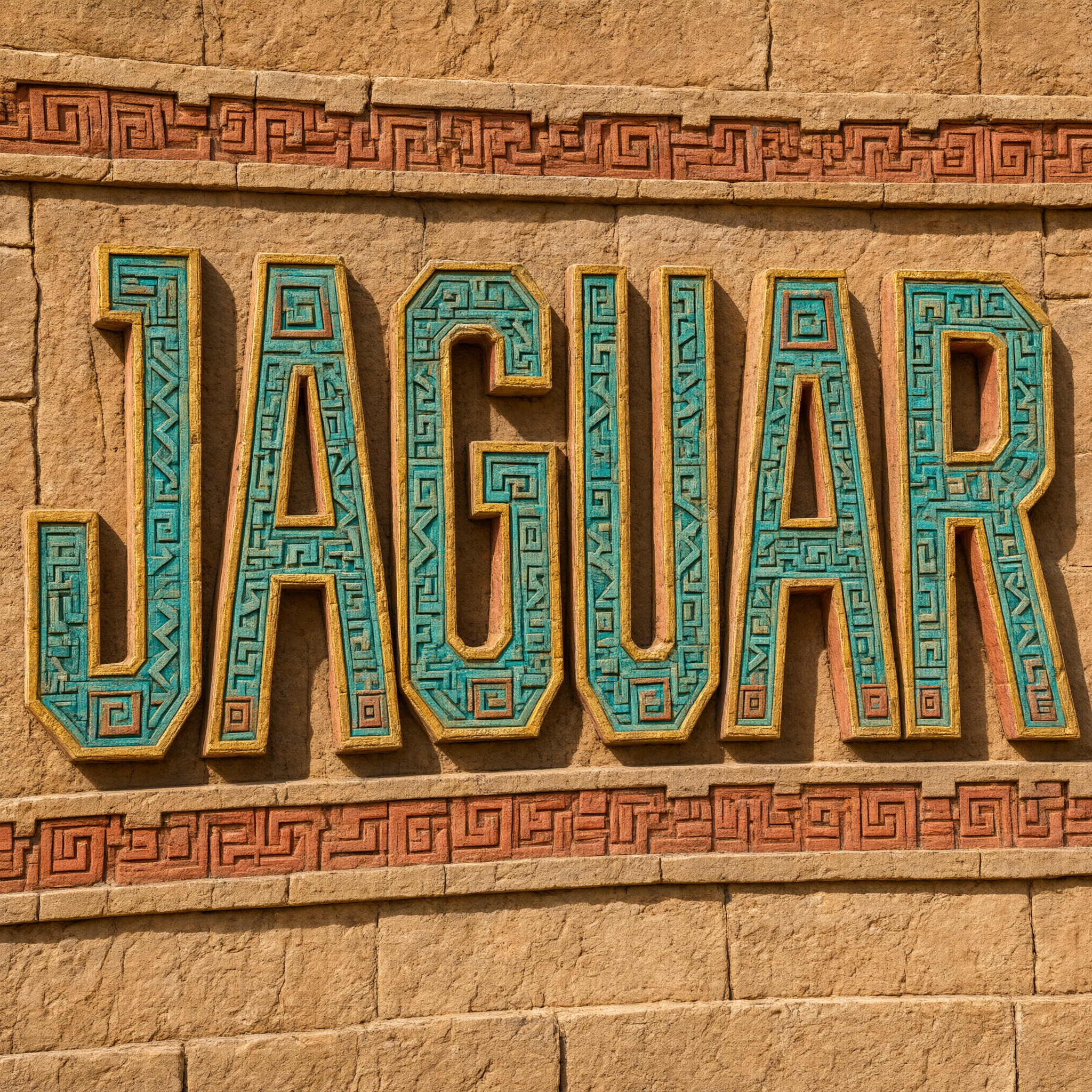
One prompt pasted into each image model as-is. These are the unedited results, so you can pick the model that suits you.
Stepped turquoise and terracotta blocks between carved fret bands.
A deep-set panel with a fret border and muted, dusty colours.
Fine fret patterns inside each letter on a weathered, cracked wall.
Smaller letters with softer colours on a plainer wall.
Mostly turquoise letters with bright gold outlines, tightly cropped.
The button opens FontVibe's DIY mode with this prompt already filled in, as-is, so you only type your word, pick a model and generate. GPT Image, Nano Banana, Seedream, Grok and Qwen are all there under one account instead of five separate apps, so you can see which one keeps the stepped letters readable under all the carving. Every account gets free credits each month with no card needed, and you can export a transparent PNG for shirts, posters and stickers.
Layers in the order the prompt states them. Change one layer and the rest keeps working.
Every AIFont prompt opens with the same text part. "Spell it exactly as written, without adding or changing any letter" comes first, so the model settles the spelling before it starts turning curves into steps. Heavy decoration is where letters get swapped or doubled.
"Aztec lettering" tells the model which carved, geometric look to reach for. On its own it can wander into tribal tattoo or generic Southwest motifs; the sentences after it pin it down.
"bold, blocky capital letters built only from straight lines and right-angle steps" is the shape. An O becomes a stepped square, an S a run of right angles. This is the part that makes it look carved from blocks rather than drawn with a pen.
"each letter filled with carved geometric patterns of stepped frets, zigzags and small square spirals like a stone relief" puts the decoration inside each stroke, where Mesoamerican carvers put it, not around the word. "every letter reads at a glance" keeps the patterns from swallowing the letters.
"The letters are turquoise and terracotta with gold outlines." is the colour sentence, and the one to change if you want a different palette. The gold outline keeps each letter's edge clear against the patterns.
"The surface looks like painted carved stone with slightly worn edges." The Templo Mayor and the calendar stone were both painted, so colour on stone is not a modern add-on. The worn edges stop it looking like plastic.
"Like the carved lettering on an Aztec temple frieze." gives the model one picture to aim at: a long carved band on a temple wall.
"The word is carved into a sunlit sandstone wall with a stepped border." shows the letters as carving, with low sun picking out every step. "The word is centered, spans most of the width and reads clearly." keeps the word the star. Swap the wall for a poster, a shirt or a jungle ruin; the letters stay the same.
Small edits that stay on-style. Change one thing at a time.
Type it in the box next to Prompt above and copy again. Short words of four to eight letters work best: every letter carries its own pattern, and long phrases shrink the carving.
Change "The letters are turquoise and terracotta with gold outlines." to "The letters are jade green and gold.", "The letters are deep red and black with gold outlines." or "The letters are bone white with turquoise outlines."
Replace "carved into a sunlit sandstone wall with a stepped border" with "carved into a mossy temple ruin in the jungle", "printed across the front of a black T-shirt" or "painted on a bright orange restaurant wall".
The prompt sets no frame size. Pick 16:9 in your app, or add "Wide 16:9 image." at the end for banners and game title screens.
AI fonts that share the most tags with Aztec Font.
 Premium
AI fonts for a second line, a logo lock-up or a poster footer.
Aztec Font writes your word in bold, blocky capitals made only of straight lines and right-angle steps, with no curves anywhere. Each letter is filled with carved geometric patterns, stepped frets, zigzags and small square spirals, like a stone relief. The letters are turquoise and terracotta with gold outlines, and the surface looks like painted carved stone with slightly worn edges.
Type your word in the box above the prompt, copy it, and paste it into ChatGPT, Gemini, Grok or any other AI image app. The prompt has three parts: the text, the font design and the scene. The font design is what makes it Aztec-style; the scene is yours to change. Every image on this page was made by pasting the prompt unchanged into each model, and nothing was retouched.
Use it for Mexican restaurant and festival posters, Chicano-inspired art and tattoo sketches, adventure game titles and T-shirt prints.
Details from the original render. Every one of them is named in the prompt.
Letters built only from straight lines and right-angle steps, no curves.
Stepped frets, zigzags and small square spirals carved inside each letter.
Turquoise and terracotta letters edged in gold.
A painted, carved-stone surface with slightly worn edges.
Pulled from the render. Handy when you build the rest of the design around the word.
Where this AI font earns its keep.
There were never Aztec capital letters to copy. The Mexica, the people usually called Aztecs, wrote Nahuatl with pictographic and logographic signs, not an alphabet. What this style borrows is their stone. Its main motif is the stepped fret, xicalcoliuhqui in Nahuatl, a name that means twisted gourd: three or more steps joined to a hook or spiral. It turns up all over Mesoamerica, on sculpture, textiles, codices and temple walls, from the fretwork of Mitla in Oaxaca to El Tajín in Veracruz, and no single meaning for it is agreed.
In Tenochtitlan, the Mexica capital, work on the Templo Mayor began some time after 1325, and the whole building was originally covered with stucco and polychrome paint. The Aztec calendar stone, a basalt disc 3.6 metres across carved between about 1502 and 1521, was rediscovered in 1790 during repairs to Mexico City's cathedral, and a 1939 study found evidence that it had been painted bright blue, red, green and yellow. That is why the prompt asks for painted carved stone rather than bare grey rock.
The imagery travelled north. Chicano artists used Aztec and Mesoamerican imagery to assert an indigenous identity, in murals such as those in Chicano Park and in prints, dance and music.
Sources: Wikipedia — Xicalcoliuhqui · Wikipedia — Templo Mayor · Wikipedia — Aztec calendar stone · Wikipedia — Aztec writing · Wikipedia — Chicano art movement
Work on the first Templo Mayor in Tenochtitlan begins some time after 1325; the temple is rebuilt six times and covered with stucco and polychrome paint.
The Aztec calendar stone, a 24-tonne basalt disc, is rediscovered on 17 December 1790 during repairs to Mexico City's cathedral.
On 21 February 1978 electricity workers digging in central Mexico City find the Coyolxauhqui stone, leading to the excavation of the Templo Mayor.
Every model spelled the word right in English, Spanish, Portuguese, German, Japanese and Chinese, all as blocky turquoise and terracotta letters with gold outlines. GPT Image fills the letters with the boldest stepped blocks, Nano Banana carves the finest fret patterns, and Qwen keeps mostly to turquoise. Arabic is the hard one for this square-built style: GPT Image, Nano Banana and Grok got it right, while Seedream misplaced a dot and Qwen dropped a letter, both failing twice. Compare them side by side above.
No. The Aztecs wrote Nahuatl with pictures and signs that stood for words, ideas and some sounds; there was no alphabet. This prompt draws ordinary Latin letters (or the script of your own language) and decorates them with stepped frets and zigzags inspired by Mesoamerican stone carving. It is a decorative style, not a way to write in Aztec glyphs.
Yes. Chicano artists have drawn on Aztec imagery to speak about indigenous heritage, in murals such as those in Chicano Park. For Día de Muertos, keep the letters and set the scene, for example "painted on a Día de Muertos altar with marigolds". For lettering from the Chicano tattoo and wall tradition itself, see Chicano Script or Cholo Block Letters. The stepped fret has no single agreed meaning, so the prompt uses it as pattern, not as a sacred sign.
Type it in the box next to the prompt and copy the full prompt again. Check the result letter by letter: heavy carving can hide a missing or doubled letter.
Change only "The letters are turquoise and terracotta with gold outlines.", for example to "The letters are jade green and gold."
Pick the ratio in your app if it has one. If not, add "Wide 16:9 image." or "Tall 4:5 image." at the end of the prompt.
No. It is a prompt, not a .ttf or .otf file. You paste it into an image model and it draws your word as finished carved lettering, so there is nothing to install and any word works.
Copying the prompt is free. Whether the image costs anything depends on the app you paste it into, and what you may do with the image depends on that app's terms.